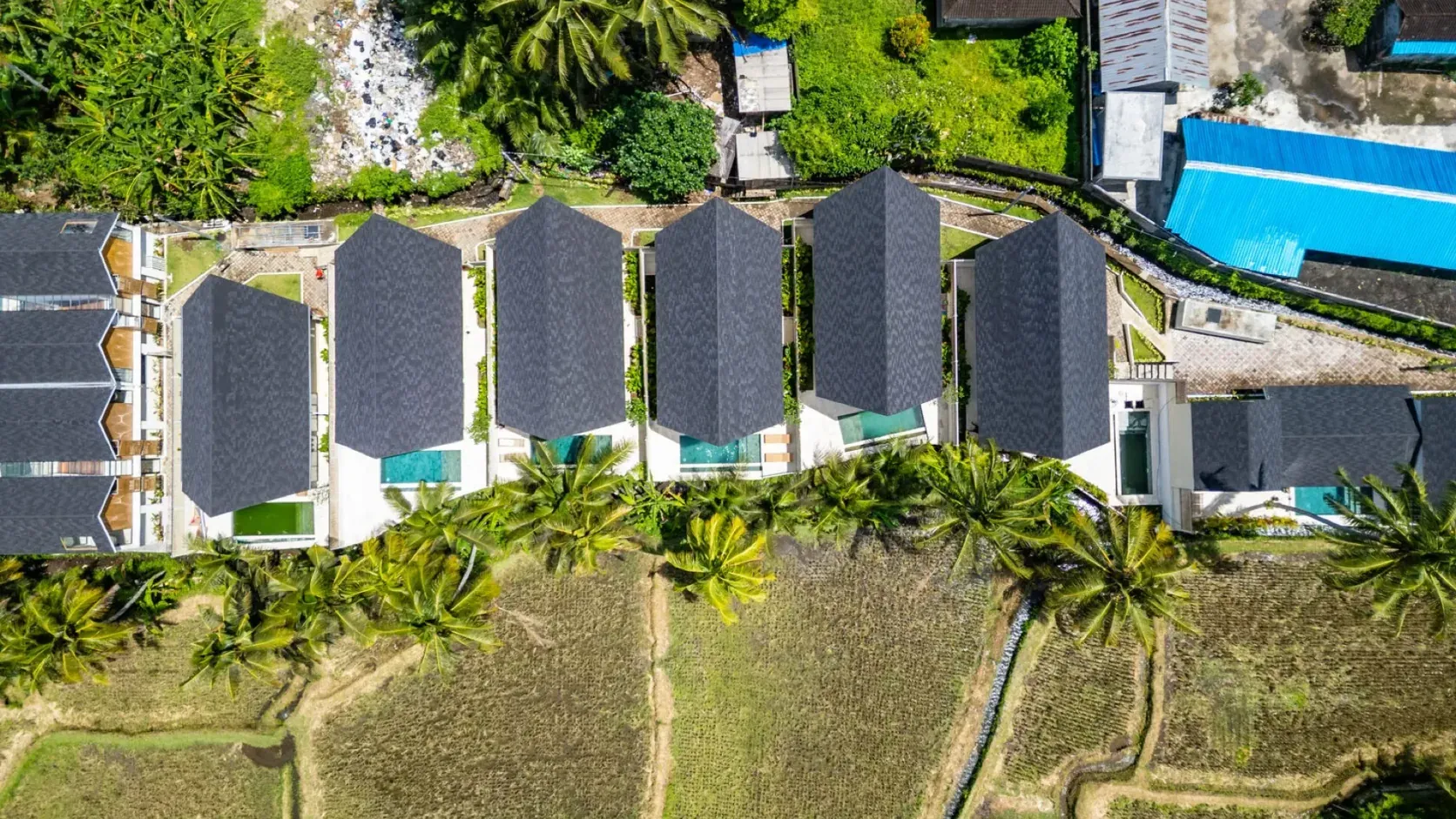
Buying off-plan property in Bali: how to judge construction risk before you pay
Off-plan property in Bali is only as safe as the builder behind it. How to check permits, read construction progress from abroad, match payments to stages and judge the guarantee.
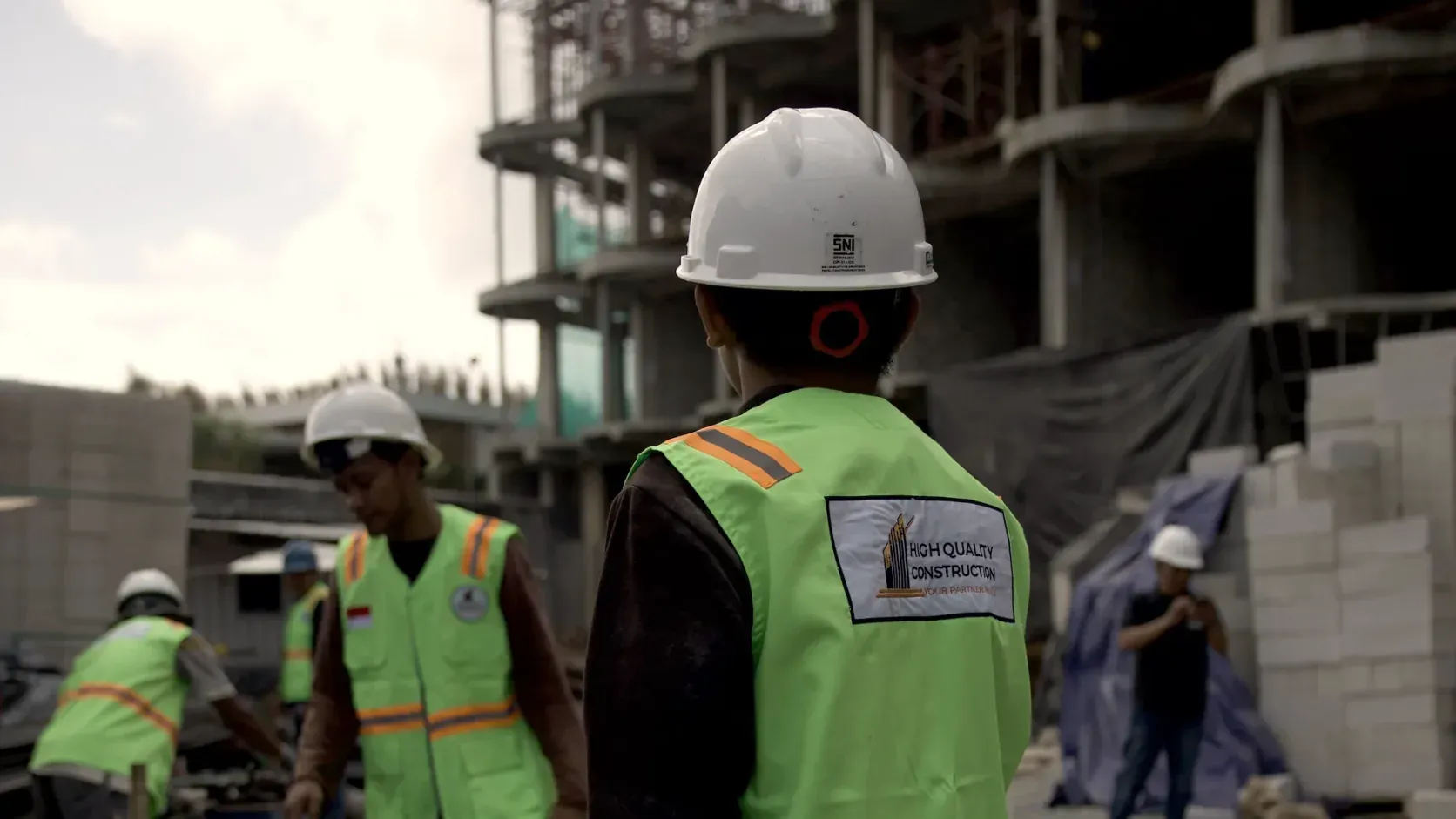
Buying off-plan property in Bali can be a sound decision when three conditions hold: the building permit (PBG) exists before work starts, payments follow construction stages you can verify, and the developer publishes dated progress from the site. The real risk sits with the builder, not with the off-plan format. Judge the team that pours the concrete, the paper trail behind the project and the guarantee in the contract before you pay.
Why do investors buy off-plan property in Bali?
Many new villas and branded apartments in Bali are sold while they are still being built. For an investor, buying off-plan has three practical advantages. You enter earlier, often with the widest choice of units, views and layouts. You pay in instalments during construction instead of in one sum. And you hold an asset whose value can rise as the building moves from drawings to a finished, operating property.
That last point needs care. At company level, HQC states up to 35% value growth by completion. It is a company-level indicator, not a guarantee and not a forecast for any single unit. What turns that potential into a result is simple and unglamorous: the building has to be finished, on the permits it was sold with, to the specification you signed for.
What can go wrong with an off-plan villa in Bali?
When off-plan purchases in Bali go wrong, the causes are usually familiar. In our experience as builders, five account for most of the trouble:
- Delays. Weather, material shortages, labour and, above all, poor planning push completion dates back. A delay costs you rental seasons and ties up capital.
- Missing or wrong permits. A project that starts without a PBG, or on land zoned for agriculture or green belt, can be stopped, fined or demolished.
- Specification substitution. The render shows one quality of window, waterproofing or electrical fitting; the site installs a cheaper one. This is hard to see once walls are plastered.
- A long contractor chain. When the developer only sells and a chain of subcontractors builds, responsibility for defects gets diluted between them.
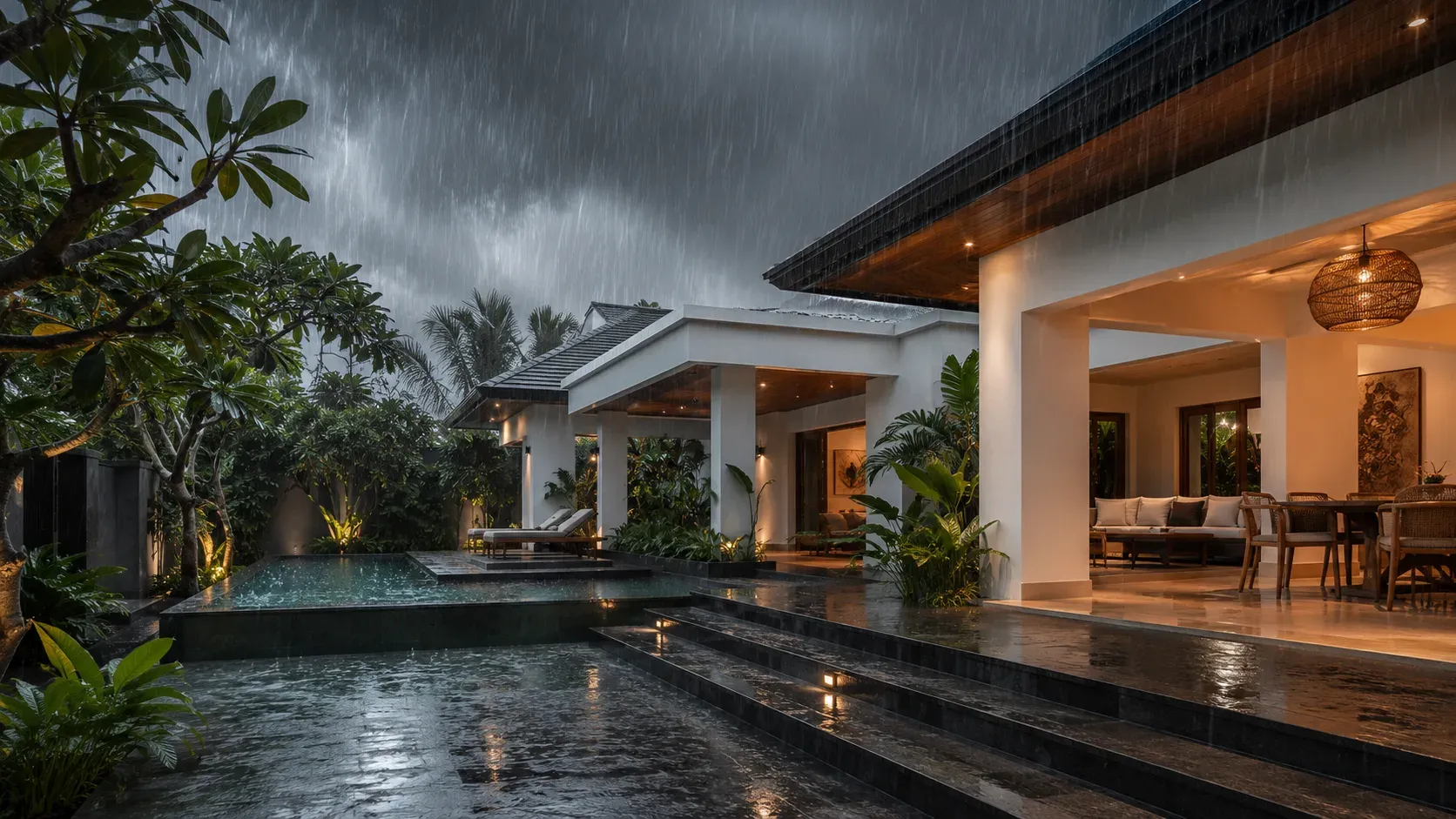
- Water, drainage and ground. Bali's rainy season and humid air expose shortcuts in drainage, waterproofing and foundations within the first year or two.
None of these is unique to Bali, and none is a reason to avoid off-plan. Each one leaves traces you can check before signing and while the building goes up. For what the tropical climate does to a building over time, see what tropical climate does to buildings.
Which permits should exist before you pay for an off-plan project in Bali?
Indonesia's permit logic runs in a fixed order. First, the land must be zoned for the intended use: the spatial-use conformity approval, known as KKPR, together with the environmental approval the project requires. Second, the building design must be approved through the PBG (Persetujuan Bangunan Gedung), which replaced the old IMB under the 2020 Job Creation Law and is regulated by Government Regulation 16 of 2021. The PBG is issued before construction starts. Third, when the building is finished, an inspection leads to the SLF (Sertifikat Laik Fungsi), the certificate of functional fitness. Under Article 274 of the same regulation, the owner must hold the SLF before the building is used.
As of 2026, Government Regulation 28 of 2025 on risk-based business licensing, issued on 5 June 2025, keeps KKPR, environmental approval, PBG and SLF as basic requirements. Enforcement is real. In July 2025 the Governor of Bali, Wayan Koster, oversaw the start of demolitions at Bingin Beach of close to 50 villas, guesthouses, restaurants and bars built without permits on land zoned as green belt, as ABC News reported. These were operating tourism businesses, not off-plan projects, but the principle is the same: a building without the right zoning and permits can be removed.
For an off-plan buyer, the practical rule is about timing: zoning and the PBG should exist before your first payment, not arrive later in the build, and the contract should say how and when the SLF will be obtained before you take the keys. The full document list, including land certificate and lease checks, is in our due-diligence checklist for buying in Bali. If you plan to rent the villa to guests, the PBG must also cover the right building function; our guide to villa management and rental licences explains why. The lease itself is compared with other structures in leasehold vs freehold in Bali.
How do you check construction progress from abroad?
Most of our buyers live outside Indonesia and visit Bali a few times a year at most. They need to be able to read a construction site from a screen. Three things make that possible.
Know the stage sequence
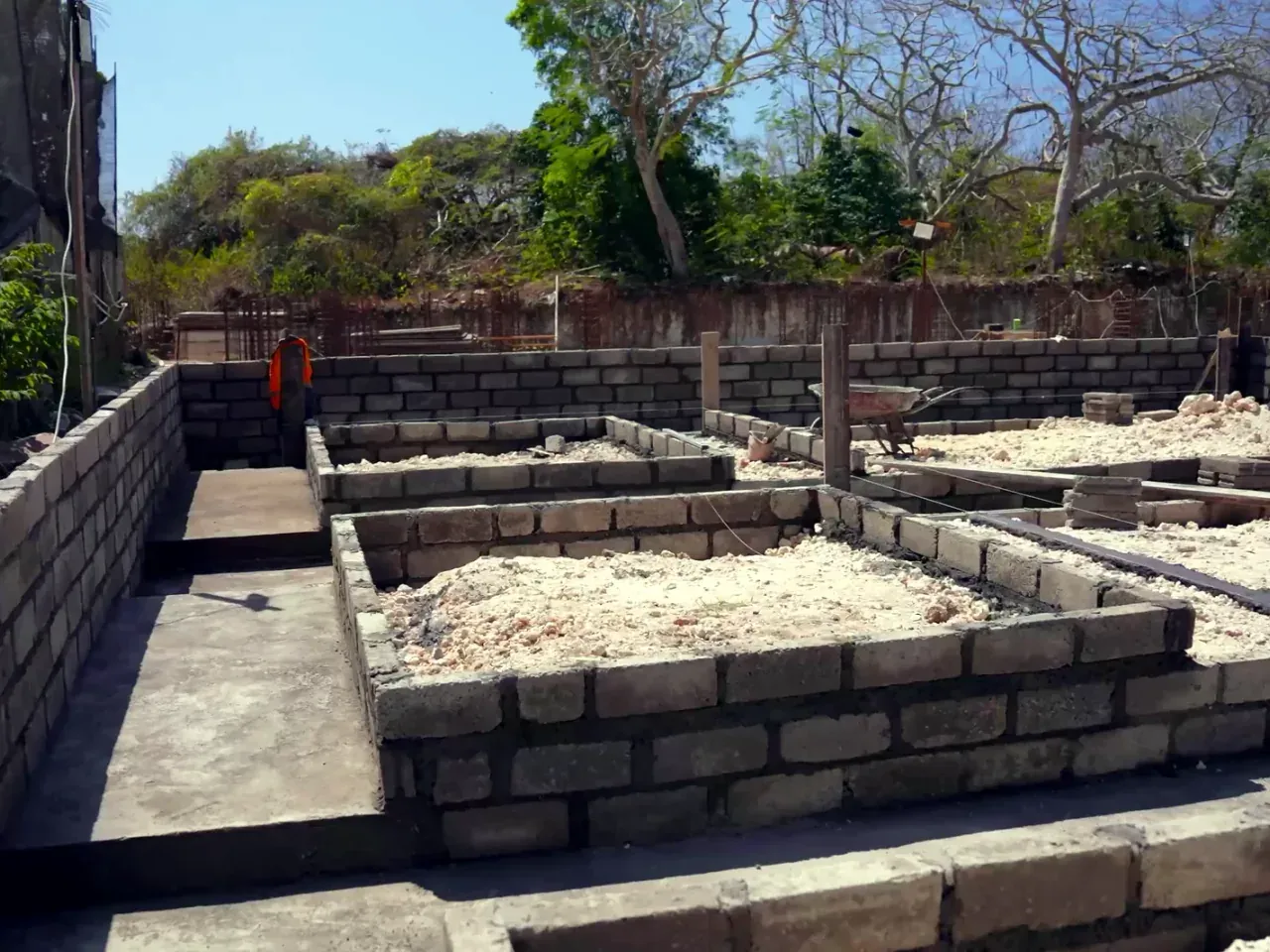
Every villa or apartment block follows the same order: site preparation and excavation, piles and foundations, the structural frame and slabs, the roof, the building systems (mechanical, electrical and plumbing, or MEP), then finishing, joinery and furniture. Knowing the order lets you judge a report. A project that shows finished interiors in the brochure while the site photos show only excavation is telling you where it really is.
Insist on dated photo, video and drone reports
A useful progress report is dated, names the building or block, and shows the same views from one report to the next, so change is visible. Drone footage shows the whole site at once: how many buildings are standing, whether roofs are on, whether landscaping has started. Undated marketing photos prove nothing about progress. If a developer cannot tell you what was done on site last month, treat that as an answer.
What a site visit should show you
When you visit, ask to see the part of the project that matches the latest report, not only the show unit. Look for a permit board at the entrance, organised material storage, and waterproofing and drainage work before it is covered. Ask who the site engineer is and whether the workers are the developer's own teams or a subcontractor's. A confident builder will walk you through the structure, not just the showroom.
How should off-plan payments track construction risk?
The payment schedule decides how much of your money is exposed if the site slows down. In a time-linked plan, instalments fall due on calendar dates, whatever happens on site. In a stage-linked plan, each instalment falls due when a defined construction stage is complete. Stage-linked payments keep your exposure at the same pace as the building: if the site slows, so do your payments.
Indonesia's housing rules for houses and apartments sold to citizens follow the same logic: under Government Regulation 12 of 2021, a binding pre-sale agreement requires confirmed land status, an issued PBG and at least a fifth of the construction completed. Leasehold villa contracts are drafted differently, so ask your notary which protections your contract actually contains. The step-by-step purchase process, including payment stages and the documents at each one, is in how to buy property in Bali as a foreigner.
Red flags and good signs in an off-plan project
What you check | Red flag | Good sign |
|---|---|---|
Building permit | "PBG is in process" while construction is already under way | PBG number provided when asked, obtained before works start |
Zoning | Land marketed as villa-ready without written confirmation | Zoning (KKPR) confirmed in writing for the intended use |
Progress reports | Renders and undated photos only | Dated photo, video and drone reports per building |
Payments | Large sums due on calendar dates regardless of progress | Instalments linked to defined construction stages |
Who builds | Sales company with an unnamed chain of subcontractors | Named in-house teams for the frame, insulation and systems |
Track record | No finished buildings you can visit | Completed projects you can walk through |
Guarantee | Vague promises, or no written warranty | 10-year structural guarantee written into the contract |
Completion date | A date that keeps moving without explanation | A stated quarter, with progress reports that support it |
What guarantee should a new Bali villa come with?
A new villa should come with a written structural guarantee, and 10 years is the meaningful benchmark. It is not an arbitrary number. As of 2026, Article 65 of Law 2 of 2017 on Construction Services makes a contractor liable for building failure for a maximum of 10 years after final acceptance of the construction works, where the planned service life of the building is longer than that, and requires the period to be stated in the construction contract. The law has since been amended by the Job Creation legislation (Law 6 of 2023), so confirm the current wording with your lawyer. A structural guarantee of the same length means the developer stands behind the load-bearing structure for the period the law recognises.
Finishing is a different category: paint, tiles and fittings wear with use and climate. At HQC, finishing carries a 12-month guarantee. Who performs the guarantee matters as much as its length. When the developer's own teams built the frame and installed the systems, the company that answers the warranty call is the same one that did the work.
How HQC reports construction
We build with in-house teams. Our own crews install the structural frame, seismic and hydro insulation, finishes, joinery and building systems, so one company is accountable for each stage. MEP work is checked by our own laboratory, electrical systems use ABB equipment and lifts are KONE, and furniture comes from our own 4,000 m² factory. Quality control runs in three stages, engineering, finishing and operator inspection, with photo and video records at each. On site, the step we refuse to rush is waterproofing of underground structures: it is inspected before backfill, because once soil covers it, a defect can only be found by the water that comes through. The details are on our quality page.
Progress is public. Our construction reports page carries dated site updates for each project under construction, alongside walk-through videos on our YouTube channel. Building permits (PBG) have been obtained for Satori and for Bloom, BY Radisson Individuals, and Satori's instalment plan runs through the end of construction. The stated completion dates are: Satori, Q3 2027; Bloom, BY Radisson Individuals, Q1 2028; Aravita, Q2 2028; the Ardhana hotel, Q3 2028. Every contract carries the 10-year structural guarantee.
Our completed work is the other half of the evidence. Construction of Black Rock was completed in August 2024, and the villas have been operating since. Construction of Dzen Green Fields was completed in May 2025, and all ten villas are sold. Ask us which completed buildings can be viewed during your visit. More on who we are and how we work is on why HQC.
Frequently asked questions
Is it safe to buy off-plan property in Bali?
Yes, when the project has a PBG before construction starts, payments follow verifiable construction stages and the developer publishes dated progress reports. The risk lies in the builder's discipline and paperwork, and both can be checked before you pay.
What are the main risks of buying an off-plan villa in Bali?
The main risks are construction delays, missing or wrong permits, cheaper materials substituted for the ones you were promised, and defects diluted across a chain of subcontractors. Drainage and waterproofing shortcuts show up in the first rainy seasons.
What permits should an off-plan project in Bali have?
It should have zoning confirmation (KKPR) for the intended use and a PBG building approval issued before construction starts. When the building is finished, it needs an SLF certificate of functional fitness before anyone uses it.
How can I check a Bali developer's construction progress from abroad?
Ask for dated photo, video and drone reports that name each building and repeat the same views, then compare them with the stage sequence: foundations, frame, roof, building systems, finishing. Confirm what you see in the reports on a site visit.
What happens if an off-plan project in Bali is delayed?
Your contract decides it, so read the delay clause before you sign: it should name a completion quarter, a grace period and what you are entitled to if the quarter is missed. Stage-linked payments limit your exposure in the meantime, because instalments fall due only when stages are complete.
Is a 10-year structural guarantee required by law in Indonesia?
Not as a developer's sales warranty, but Indonesian construction law (Article 65 of Law 2/2017) makes the contractor liable for building failure for up to 10 years after final acceptance, which is why a written 10-year structural guarantee is the benchmark. Finishing is usually covered for a shorter period; at HQC it is 12 months.
Talk to the people who build it
If you are weighing an off-plan purchase, ask us the questions in this article: the permit numbers, the latest site report, the payment stages. Talk to the HQC team or request the project catalogue, and we will show you the site as it stands today.
Continue reading
What a tropical climate does to a building — and how to build against it
Bali Real Estate Investment: The Best Areas to Buy Property in 2026